

Explore Drying Options by Feed Condition
You do not need to select a dryer model before contacting us. Start with your feed condition, and Meibao will assess suitable options based on your material data and finished-product requirements.
Spray-dried particle size and form depend on the material, atomization and drying conditions. Additional agglomeration or particle finishing can be evaluated where required.
For specific materials, tower circulation, superheated steam and combined drying processes can also be assessed separately. Final configuration depends on material data and testing where necessary.

Rotary drum drying equipment for granular, crystalline and bulk materials
| Equipment Type | Potential Feed Conditions | Drying Method and Selection Considerations |
|---|---|---|
| Spray Drying Equipment | Pumpable solutions, emulsions and slurries suitable for atomization | Atomizes liquid feed into hot air to produce dry powder. Selection considers solids content, viscosity, atomization method and required particle size. |
| Rotary Drying Equipment | Granular, crystalline and bulk materials suitable for tumbling | Dries material as it tumbles through a rotating drum. Selection considers throughput, sticking tendency, abrasiveness and particle strength. |
| Pneumatic Drying Equipment | Dispersible powders and fine particles | Disperses, conveys and dries material in a hot gas stream. Suitability depends on whether the target moisture can be reached within a short residence time. |
| Flash Drying Equipment | Suitable filter cakes, pastes and agglomerated wet materials | Uses feeding and dispersion arrangements selected for the material to promote contact with hot gas. Selection considers stickiness, dispersion requirements and feed stability. |
| Fluidized Bed Drying Equipment | Particulate materials with suitable fluidization characteristics | Uses gas flow to fluidize material for drying or cooling. Selection considers particle size distribution, fluidization behavior and particle breakage. |
| Belt and Tunnel Drying Equipment | Materials suitable for belt loading or tray handling | Uses controlled hot-air zones and residence time. Selection considers bed depth, drying uniformity and product quality. |
-
![Rotary Kiln Drying Line]() Rotary Kiln Drying LineRotary Kiln Drying Line - High-Performance & Reliable Drying Systemview more
Brand: Meibao
Warranty: 1 Year
Minimum Order Quantity (MOQ): 1 Ton/hour
FOB Ports:... -
![Airflow Drying System]() Airflow Drying SystemBrand: Meibaoview more
Warranty: 1 Year
Minimum Order Quantity (MOQ): 1 Ton/hour
FOB Ports: Shanghai/Ningbo
Certifications: ISO 9001
Packaging: Export Standard... -
![Industrial Spray Drying Machine]() Industrial Spray Drying MachineIndustrial Spray Drying Machine / Lab Scale Spray Dryer with Spray Towerview more
-
![High Productivity Spray Drying Machine]() High Productivity Spray Drying MachineHigh Productivity Spray Drying Machine with Spray Tower for Fine Powder Productionview more
-
![High Speed Spray Drying Machine]() High Speed Spray Drying MachineHigh Speed Spray Drying Machine / Industrial Spray Dryer for Liquid to Powder Conversionview more
-
![Small Scale Spray Drying Machine]() Small Scale Spray Drying MachineSmall Scale Spray Drying Machine / Ceramic Spray Dryer for Pilot & Industrial Applicationsview more
-
![Stainless Steel Laboratory Spray Dryer]() Stainless Steel Laboratory Spray DryerStainless Steel Laboratory Spray Dryer / High-Speed Spray Drying Machineview more
-
![Industrial Rotary Kiln Drying Machine]() Industrial Rotary Kiln Drying MachineIndustrial Rotary Kiln Drying Machine / Outdoor Energy Saving Rotary Dryerview more


Match the Supply Scope to Your Project
A typical hot-air drying system includes:
- Material handling: Controlled feeding, the main dryer, product collection and any required cooling, screening or conveying.
- Hot-air supply: A hot-air generator or air-heating unit selected for the available energy source.
- Exhaust treatment and controls: Gas–solid separation, any additional exhaust treatment, process monitoring and equipment interlocks.
In systems where product leaves the dryer with the gas stream, such as many spray, pneumatic and flash drying configurations, gas–solid separation also recovers the product. Further exhaust treatment is selected according to exhaust characteristics and emission requirements.
For retrofit projects, share your current throughput, operating issues, improvement targets and available equipment data or process diagrams. This helps identify which components can be retained and which require modification.
The quotation will define Meibao’s supply scope, customer-provided facilities, interface requirements and on-site services.
| Your Project Situation | Potential Scope of Supply |
|---|---|
| Existing supporting facilities; a new or replacement dryer is required | Main dryer and necessary accessories, with a compatibility review of existing facilities. |
| Existing production line; an additional drying stage is required | An integrated drying unit with the required feeding, heating, collection and control equipment. |
| New project; the complete drying section needs to be configured | A complete drying system, with engineering, manufacturing, installation, commissioning and training as agreed. |

Typical hot-air drying system configuration and scope of supply
Balance Drying Duty, Product Quality and Operating Costs
Feed rate and inlet and target moisture contents are used to estimate water evaporation. Heat demand is then assessed with allowance for material heating, exhaust losses and other system heat losses. Dryer type and size also depend on drying behavior, residence time and product requirements.
If the moisture reporting basis is unclear, a test report can help clarify it.
Heat-supply options are evaluated against local energy prices, supply reliability, product cleanliness requirements and maintenance needs to assess energy use and operating costs.
- Direct-fired hot-air supply: Used where the process permits combustion products to contact the material, with gas temperature and flow matched to the dryer.
- Indirect-fired hot-air supply: A heat exchanger separates combustion flue gas from process air before the heated air enters the dryer.
- Steam or waste-heat supply: Evaluated for air heating or another suitable arrangement according to available temperature, heat output and supply stability.
Fuel options may include natural gas, fuel oil, biomass or coal, depending on local availability and process suitability. Heat-source outlet temperature is not the same as actual material temperature.
| Selection Factor | Information to Confirm |
|---|---|
| Required throughput | Wet-feed rate or finished-product output, including units and daily operating hours. |
| Moisture and solids content | Initial and target moisture contents, including the reporting basis; solids content for liquid feeds. |
| Material properties | Feed condition, particle size, sticking tendency, heat sensitivity and corrosiveness; liquid viscosity at the stated temperature. |
| Product requirements | Product form, particle size, allowable material temperature, color, particle integrity and cleanliness. |
| Site conditions | Available energy sources, installation space, existing equipment interfaces and emission requirements. |

Equipment selection and heat-supply matching for industrial drying lines
Explore Drying Systems by Material
Quartz Sand Drying Line
Fertilizer Drying Line
Feed Drying Line
Ceramic Drying Line
Kaolin Drying Line
Other chemical powders, granules and industrial by-products can be assessed according to their material characteristics and processing requirements.
Start with Your Material and Production Goals
Tell us what you need to dry, your expected throughput and whether you are planning a new installation or modifying an existing system.
Share any available feed and target moisture data, product specifications, energy options and site information. Details that are not yet known can be clarified during the discussion.
Meibao will review the available information to identify potential equipment options, supporting systems and additional technical data needed for a proposal and quotation.
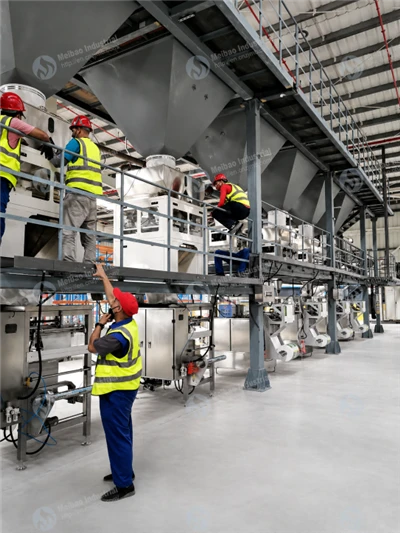
Zhejiang Meibao Industrial Technology Co., Ltd. is one of the most professional active material raw material drying line manufacturers and suppliers in China, featured by quality products and good price. Please rest assured to buy custom made active material raw material drying line from our factory.
active material raw material drying line