


Industrial Hot Air Systems Designed Around Your Production Process
Industrial hot air furnaces are widely used for drying, heating, spray drying and other production processes requiring a stable supply of process hot air.
The right heating system should not be selected only according to furnace capacity or equipment purchase price.
Energy availability varies significantly between countries and regions, while different products also have different requirements for hot air temperature, cleanliness, continuous operation and automation.

What Meibao Evaluates
- Product to be dried
- Hot air application
- Production capacity
- Initial and final moisture content
- Required hot air temperature
- Exhaust air temperature
- Daily operating hours
- Locally available energy sources
- Fuel price and supply stability
- Hot air cleanliness requirements
- Local environmental and emission requirements
- Furnace capacity and downstream matching
Based on these conditions, we develop the complete system covering fuel supply, combustion, hot air generation, heat exchange, fans and ductwork, exhaust treatment and automation.
Request a System AssessmentSelect the Hot Air Furnace According to Local Energy Conditions
The most suitable energy source can vary considerably from one project location to another. Meibao provides different industrial hot air solutions according to local fuel resources, energy prices, production scale and process requirements.

Biomass-Fired Hot Air Furnace
Biomass-fired systems can operate with wood chips, sawdust, biomass pellets, wood-processing residues and other suitable biomass fuels. In regions where biomass resources are readily available while natural gas or fuel oil is relatively expensive, biomass can help optimize the factory's energy structure and reduce long-term process-heating costs.
Suitable for:
- Regions with abundant biomass resources
- Large-scale continuous industrial drying
- Natural rubber drying
- Detergent powder spray drying
- Fertilizer, ceramic and mineral drying
- Conversion from existing oil- or gas-fired heating systems

Coal-Fired Hot Air Furnace
Where coal is readily available, reliably supplied and economically competitive, a coal-fired hot air system can provide an effective industrial heat source. The combustion system is configured according to actual coal properties, including calorific value, moisture, ash content, sulfur content and local environmental requirements.
Suitable for:
- Regions with stable coal resources
- High heat-load applications
- Long-term continuous production
- Detergent powder spray drying
- Fertilizer and mineral drying
- Other large-scale industrial drying processes
Coal feeding, combustion, dust collection and flue-gas treatment systems can be integrated according to project conditions.
Explore Coal-Fired Hot Air Furnace Solutions →
Oil-Fired Hot Air Furnace
Depending on local liquid-fuel availability, the system can operate with heavy fuel oil or light diesel oil. Heavy fuel oil systems generally focus more on long-term fuel economics for large continuous production. Light diesel systems generally offer faster start-up, flexible regulation and simpler fuel handling.
Suitable for:
- Regions with reliable fuel-oil supply
- Production systems requiring rapid start-up
- Projects with changing production loads
- Detergent powder spray drying
- Chemical, mineral and industrial-material drying
- New projects and existing heating-system upgrades

Gas-Fired Hot Air Furnace
Depending on the available gas source, Meibao gas-fired hot air systems can be configured for pipeline natural gas, LNG, LPG, producer gas, blast furnace gas (BFG), coke oven gas (COG) and other combustible industrial gases after technical evaluation.
Key advantages:
- Fast start-up and flexible temperature regulation
- Convenient automatic control
- Suitable for rapid response and flexible load adjustment
- Industrial by-product and low-calorific-value gases can be evaluated by calorific value, composition, pressure and available flow
Direct-Fired or Indirect Heat-Exchange System?
After selecting the energy source, another important question is whether the product can directly contact combustion flue gas. The answer determines whether a direct-fired or indirect heat-exchange hot air system is more suitable.

Direct-Fired Hot Air Furnace
Combustion heat is supplied directly to the production process after the required temperature regulation and hot air treatment.
Main Advantages
- Direct heat-transfer process
- High heat-utilization efficiency
- Suitable for relatively high heat loads
- Suitable for continuous production
- Can be integrated with different industrial drying equipment
Typical Applications
- Detergent powder spray drying
- Fertilizer drying
- Ceramic and mineral powder drying
- Selected chemical-material drying
- Industrial raw-material and product drying
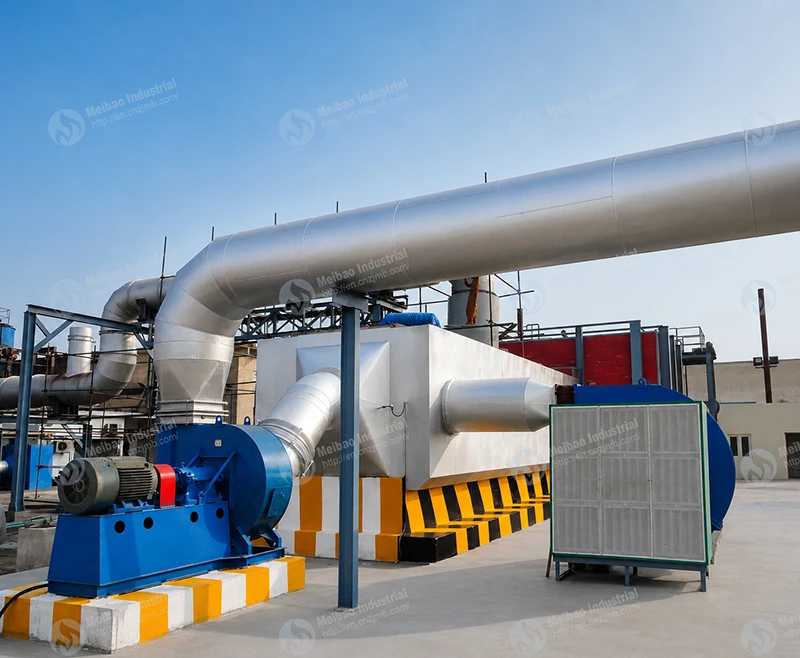
Indirect Hot Air Furnace with Heat Exchanger
High-temperature flue gas generated by fuel combustion transfers heat to clean air through a heat exchanger. The combustion flue gas and process hot air remain separated, so the product does not directly contact combustion flue gas.
Main Advantages
- Higher process-air cleanliness
- Reduced influence of flue gas on product color and odor
- Better control of product quality
- Suitable for continuous industrial operation
- Suitable for both new projects and existing heating-system upgrades
Typical Applications
- Natural rubber drying
- Products with higher color and odor requirements
- Industrial drying requiring cleaner process air
- Materials that must not directly contact combustion flue gas
Compare Long-Term Operating Costs, Not Only Fuel Prices
Energy selection should not be based only on the purchase price of the fuel. A lower-priced fuel does not necessarily result in a lower actual process-heating cost.

A proper evaluation should also consider
- Fuel Lower Heating Value
- Fuel moisture content or quality
- Actual fuel consumption
- Combustion efficiency
- Fuel transportation and storage
- Fuel-treatment requirements
- Daily and annual operating hours
- Automation and labor requirements
- Environmental-treatment costs
- Long-term fuel-supply stability
For projects where several energy sources are available, Meibao can compare different heating options based on local energy data.
Biomass vs Natural Gas
Compare biomass price, Lower Heating Value, moisture content and transportation cost with the local natural-gas price.
Coal vs Biomass
Evaluate calorific value, ash content, sulfur content, environmental-treatment requirements and long-term operating cost.
Heavy Fuel Oil vs Light Diesel
Compare fuel price, calorific value, heavy-oil preheating requirements, fuel-handling complexity and operating hours.
Natural Gas vs Industrial By-Product Gas
Evaluate gas Lower Heating Value, pressure, available flow, pretreatment cost and long-term supply stability.
From the Hot Air Furnace to the Complete Process Heating System
A hot air furnace does not operate independently. A stable industrial heating system requires the heat source and downstream production equipment to be properly matched.

Depending on project requirements, the complete system can also include
- Automatic fuel conveying
- Combustion control
- Hot air temperature control
- Airflow regulation
- Fans and ductwork
- Heat exchangers
- Dust collection
- Flue-gas treatment
- Safety interlocks
- Centralized automatic control
The furnace capacity, production capacity and downstream equipment are designed as one coordinated system.
Industrial Applications
Meibao hot air furnaces can be integrated with different industrial production and drying systems according to project requirements.

Detergent Powder Production
Stable industrial hot air for spray drying, with coal, biomass, oil or gas selected according to local energy conditions.
Natural Rubber Drying
Indirect heat-exchange systems can provide clean process hot air where product color, odor and cleanliness are important.
Fertilizer Production
Continuous process-heating solutions configured according to production capacity, material moisture content and available energy sources.
Ceramics & Mineral Powders
Hot air systems can be integrated with rotary dryers, spray dryers and other industrial drying equipment.
Chemical & Industrial Materials
Heating systems are configured according to material properties, process temperature and hot-air cleanliness requirements.
Other Industrial Processes
Customized process-heating solutions for drying, heating and other applications requiring a stable industrial hot air supply.
How Meibao Determines the Right Hot Air Solution
Our preliminary evaluation normally follows three steps.

Evaluate the Production Process
- What product will be dried?
- Production capacity per hour
- Initial moisture content
- Required final moisture content
- Required hot air temperature
- Can the product directly contact combustion flue gas?
Evaluate Local Energy Conditions
- Coal
- Biomass
- Heavy Fuel Oil / Light Diesel
- Natural Gas / LNG / LPG
- Combustible industrial gases
- Fuel price and properties evaluated together
Match the Complete Heating System
- Hot air furnace type
- Combustion & fuel-supply system
- Heat-exchange system
- Required airflow, fans and ductwork
- Dust and flue-gas treatment
- Automatic control & safety interlocks
Selected Industrial Hot Air Furnace Projects
Meibao hot air systems have been applied in different countries and industrial production processes.


Indirect High-Cleanliness Biomass Hot Air Furnace for Natural Rubber Drying

Biomass Hot Air System for Rubber Drying

Industrial Hot Air System for Rubber Drying

High-Cleanliness Coal-Fired Hot Air Furnace

Oil / Gas-Fired Industrial Hot Air Furnace
Planning a New Industrial Hot Air System or Heating-System Upgrade?
Complex thermal calculations are not required from the customer during the initial project stage.

You can begin by providing
Product to be dried
Hot air application
Production capacity per hour
Initial moisture content
Required final moisture content
Required hot air temperature
Exhaust air temperature
Daily operating hours
Locally available fuels
Local fuel prices
Current energy source and operating cost
New project or existing-system upgrade
Local environmental requirements
Coal
- Calorific value
- Moisture
- Ash content
- Sulfur content
Biomass
- Calorific value
- Moisture content
- Fuel form
Fuel Oil
- Heavy fuel oil / light diesel
- Calorific value
- Heavy-oil viscosity
Gas
- Gas type
- Calorific value
- Pressure
- Maximum available flow
Start Your Industrial Hot Air Project
Select the right industrial heat source according to your production process and local energy conditions.
Meibao's engineering team will evaluate the heat-source type, combustion system, hot-air configuration, fans and ductwork, environmental-treatment system and automation according to the actual project conditions.
Get in touch with Meibao
Fill out the form below and our engineering team will respond within 24 hours.
Initial Project Information
If the preferred fuel is already selected, also provide: Coal (calorific value, moisture, ash, sulfur) · Biomass (calorific value, moisture, fuel form) · Fuel Oil (type, calorific value, viscosity) · Gas (type, calorific value, pressure, maximum flow).