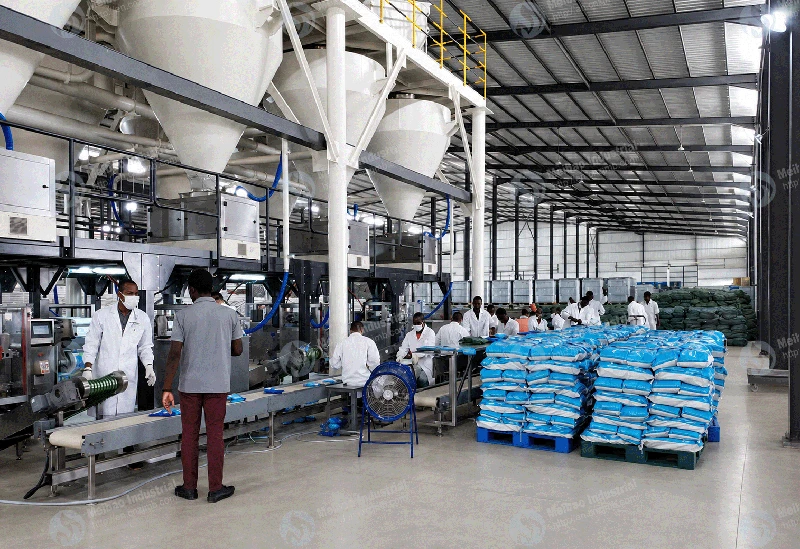
Build Your Detergent Powder Factory

From Project Planning to Commercial Production

Meibao provides customized detergent powder plant solutions for investors planning new manufacturing facilities. We integrate process engineering, plant layout, equipment manufacturing, installation, commissioning and operator training into one coordinated project.

Customized Production Capacity Process & Factory Layout Design Complete Equipment Manufacturing Installation & Commissioning Operator Training
📷 图片位置 - Hero Banner / Factory Aerial View

A Detergent Powder Factory Is More Than a Group of Machines

For a new factory investor, selecting production equipment is only one part of the project. Before manufacturing begins, the project must define the target market, detergent formula, product grade, production capacity, raw material supply, factory layout, utility conditions, environmental requirements, packaging formats and future expansion plan.

Meibao approaches the detergent powder factory as one complete production system. Our engineering team coordinates the process, equipment, heating system, dust treatment, automation, factory layout and project implementation from the early planning stage.

A Detergent Powder Factory Is More Than a Group of Machines

Key Questions Before Starting the Project

What type of detergent powder will the factory produce?
What production capacity is suitable for the target market?
Which production process matches the formula and investment plan?
What factory space and utility conditions will be required?
Which fuels are available at the project location?
What level of automation is suitable?
Which packaging sizes and formats are required?
How can the plant reserve capacity for future expansion?

One Partner for the Complete Detergent Powder Project

Meibao supports customers from the initial factory concept to production startup. The final project scope is defined according to the customer's site conditions, investment boundary and operational requirements.

1

Project Planning & Technical Assessment

We review the target products, planned production capacity, raw materials, formula characteristics, packaging requirements, local market conditions and future development objectives.

2

Process Selection & Engineering Design

The production route is selected according to the required powder density, formula, product grade, production scale and automation level.

3

Factory & Equipment Layout

We coordinate the production areas, raw material storage, slurry preparation, spray drying, post-addition, packaging, utility systems, finished-product storage and equipment maintenance access.

4

Equipment Manufacturing & System Integration

Core equipment, conveying systems, storage systems, heating equipment, dust treatment systems, steel structures and control systems are manufactured and integrated.

5

Installation & Commissioning

Meibao can provide installation guidance, equipment inspection, system commissioning, trial production and process adjustment according to the agreed project scope.

6

Operator Training & Technical Support

Operators can receive training covering equipment operation, process control, routine inspection, maintenance and production safety.

Choose the Right Production Route for Your Market

Different detergent products, formulas and investment plans require different production processes. Meibao evaluates the target product, formula, required capacity, product grade and market positioning before recommending the appropriate production route.

page-800-450

Post-Blending Detergent Powder Line

A flexible production route suitable for selected detergent powder formulas, regional brands, market-entry projects and production capacity expansion. The system can integrate raw material dosing, powder and liquid addition, mixing, screening, conveying and packaging.

Suitable For
  • New brands entering the detergent market
  • Small and medium production requirements
  • High-density or blended detergent products
  • Projects requiring relatively compact layouts
  • Phased investment and future expansion
View Post-Blending Solution →
page-800-450

Spray Tower Detergent Powder Line

A continuous industrial production route using slurry preparation and spray drying to produce detergent base powder with controlled moisture, particle structure and bulk density.

Suitable For
  • Medium and large detergent factories
  • Continuous commercial production
  • Standard and low-density detergent powders
  • Projects requiring stable base-powder production
  • Factories serving regional or national markets
View Spray Tower Solution →
page-800-450

Integrated Spray Drying & Post-Addition Line

A complete production configuration combining spray-dried base powder production with the post-addition of heat-sensitive or functional ingredients.

Suitable For
  • Multiple product grades and formulas
  • Medium- and high-grade detergent products
  • Flexible product adjustment
  • Large-scale automated factories
  • Manufacturers planning long-term product development
Discuss Your Product Plan →

From Raw Materials to Finished Detergent Powder

The final production process is customized according to the selected production route, product formula and project requirements.

page-1280-720
Raw Material Storage Weighing & Dosing Slurry Preparation Spray Drying Powder Cooling Post-Addition Screening Packaging
1
Raw Material Storage & Handling

Powder and liquid raw materials are stored and transferred according to their physical properties and production requirements.

2
Automatic Weighing & Dosing

Raw materials are measured according to the approved formula and transferred to the corresponding preparation system.

3
Slurry Preparation & Homogenization

Powder and liquid ingredients are mixed, aged, filtered and homogenized to prepare stable slurry for spray drying.

4
Hot Air Generation & Spray Drying

The slurry is atomized inside the spray tower and brought into contact with controlled hot air to form detergent base powder.

5
Base Powder Collection & Cooling

The dried powder is collected, conveyed and cooled before entering the following production stage.

6
Post-Addition & Blending

Heat-sensitive and functional ingredients are accurately added and uniformly blended according to the product formula.

7
Screening & Intermediate Storage

The finished powder is screened to control particle consistency before entering the finished-product storage system.

8
Automatic Weighing & Packaging

The detergent powder is weighed, filled, sealed, coded and conveyed according to the required packaging format.

Integrated Systems for Complete Factory Operation

Each subsystem is selected and engineered to operate as one coordinated manufacturing system.

Raw Material Storage & Conveying

Customized storage silos, tanks, hoppers, conveying equipment and feeding systems selected according to raw material characteristics.

Weighing & Dosing System

Automatic or semi-automatic dosing supports controlled material addition and repeatable production management.

Slurry Preparation System

Mixing, aging, filtration and homogenization equipment prepares the slurry required for stable atomization.

Spray Drying Tower

Converts prepared slurry into detergent base powder under controlled drying conditions.

Industrial Hot Air System

Gas, oil, coal or biomass heating solutions evaluated by local fuel availability and process requirements.

Post-Addition & Blending System

Supports controlled addition of heat-sensitive and functional ingredients after spray-drying.

Dust Collection & Material Recovery

Cyclone separation, dust collection and material recovery systems integrated per emission requirements.

Screening & Packaging System

Screening, storage, weighing, filling, sealing, coding and conveying configured to packaging format.

Automation & Central Control

PLC operation, monitoring, recipe management, parameter display, alarms and production data recording.

Designed Around Your Actual Factory Conditions

No two detergent powder projects have exactly the same requirements. Before defining the production line, Meibao evaluates the main technical and commercial conditions of the project.

Target production capacity
Detergent powder type and product grade
Formula and raw material characteristics
Required powder density and moisture
Available land and factory dimensions
Local voltage and power frequency
Water, compressed air and utility conditions
Available fuel and fuel cost
Required automation level
Packaging sizes and package formats
Local environmental and safety requirements
Available operators and maintenance capability
Future production expansion plan

Plan the Factory Before Finalizing the Equipment

For new factory projects, the equipment layout should be coordinated with the building and logistics plan from the beginning.

Main Factory Areas

Production zones
Raw material warehouses
Liquid raw material storage
Slurry preparation areas
Spray tower structures
Post-addition sections
Packaging workshops
Finished-product warehouses
Laboratories
Utility rooms
Equipment maintenance access
Personnel and vehicle routes
page-800-450

Main Planning Priorities

  • Short and logical material flow
  • Separation of raw materials and finished products
  • Safe personnel and vehicle routes
  • Sufficient equipment maintenance space
  • Suitable equipment installation and lifting access
  • Coordination of power, water, compressed air and fuel systems
  • Space reserved for future production expansion
  • Integration with factory steel structures where required

Steel Structure Factory Planning

According to the agreed project boundary, Meibao can coordinate the detergent production equipment with the factory steel structure, equipment platforms, access stairs and related installation requirements.

Build a Production System for Different Market Requirements

The production line can be configured according to the customer's planned product portfolio, formula requirements and target market positioning.

Finished Product Options

Standard household detergent powder Low-foam detergent powder High-density detergent powder Concentrated detergent powder Enzyme-containing detergent powder Colored or speckled detergent powder Industrial & institutional cleaning powder Customer-specific formulations

Packaging Options

Small retail sachets Pillow bags Gusset bags Stand-up pouches Cartons Medium-size commercial bags Large industrial bags

Select the Right Level of Automation

The automation level should match the production scale, local labor conditions, operator capability, product variety and investment plan.

Semi-Automatic Configuration

Suitable for projects that require controlled initial investment and retain more manual operation.

Automatic Configuration

Integrates material dosing, process control, conveying, monitoring and packaging operations to reduce repeated manual handling.

Centralized Control Configuration

Can incorporate PLC and centralized monitoring for key process parameters, equipment status, alarms, formulas and production records.

Main Operational Objectives

More consistent process execution Reduced manual material handling Clearer equipment status monitoring Improved production traceability Easier recipe and parameter management Better coordination between production sections

A Structured Path from Concept to Production

A clear, stage-by-stage process from your first inquiry to a running production line.

1
Project Requirement Collection

The customer provides the target product, production capacity, formula information, raw materials, site conditions, utility conditions and packaging requirements.

2
Technical Assessment & Concept Design

Meibao evaluates the production route, main equipment, preliminary layout, automation level and project boundary.

3
Technical Proposal & Scope Confirmation

Both parties confirm the production process, equipment scope, technical responsibilities, implementation conditions and commercial proposal.

4
Detailed Engineering

Detailed process design, equipment design, layout coordination and technical documentation are completed.

5
Manufacturing & Quality Inspection

Equipment is manufactured, assembled and inspected according to the approved technical requirements.

6
Packing & Delivery

Equipment is marked, packed and loaded according to the project installation sequence and international transportation requirements.

7
Installation & Commissioning

Installation, equipment inspection, no-load testing, process commissioning and trial production are carried out according to the agreed project scope.

8
Training & Project Handover

Operators receive technical training before the production system is formally handed over.

Why Investors Choose Meibao for Detergent Powder Projects

More Than Two Decades of Experience

Founded in 2002, Meibao has long-term experience in detergent production lines, industrial heating systems and complete industrial projects.

Engineering & Manufacturing Under One System

Process design, mechanical design, equipment manufacturing, inspection and project support are coordinated within one project plan.

~80,000 m² Manufacturing Facilities

The manufacturing facilities support equipment fabrication, assembly, inspection, steel structure production and project delivery.

Around 80 Technical Personnel

The technical team supports process design, mechanical engineering, electrical control, project coordination, installation and commissioning.

More Than 200 Manufacturing Personnel

Manufacturing personnel support cutting, welding, machining, polishing, assembly, inspection and shipment preparation.

Integrated Heating & Drying Capability

Meibao can coordinate the detergent spray-drying process with industrial hot air systems based on local fuel and process requirements.

Complete Project Support

Services can cover project planning, process design, equipment supply, plant layout, installation, commissioning, training and long-term technical support.

International Project Delivery Experience

The project team considers international transportation, site installation conditions, local utility conditions and overseas project coordination.

Selected Detergent Powder Projects

25 TPH Detergent Powder Production Plant
Indonesia

25 TPH Detergent Powder Production Plant

Capacity25 tons per hour
SolutionComplete detergent powder production system
ScopeProcess engineering, equipment supply and project support
View Project →
10 TPH Detergent Powder Production Line
Cuba

10 TPH Detergent Powder Production Line

Capacity10 tons per hour
SolutionRaw material handling, slurry preparation, spray drying, post-addition and packaging
ScopeComplete production line solution
View Project →
6 TPH Detergent Powder Production Line
Angola

6 TPH Detergent Powder Production Line

Capacity6 tons per hour
SolutionTurnkey detergent powder production line
ScopeDosing, slurry preparation, spray drying, post-blending and packaging
View Project →

What We Need to Prepare Your Initial Solution

To evaluate your detergent powder factory project, please provide as much of the following information as possible.

Project country and city
New factory or existing factory expansion
Target detergent products
Planned production capacity
Expected working hours per day
Available detergent formula or product specifications
Main local raw materials
Required powder density
Available land or factory dimensions
Local voltage and power frequency
Available gas, oil, coal or biomass fuel
Required packaging sizes
Preferred automation level
Target project schedule
Required project scope

Frequently Asked Questions

How much does a detergent powder factory cost? +
The investment depends on the production process, capacity, automation level, factory conditions, equipment scope, heating system, environmental requirements and packaging configuration. Meibao prepares a project-specific technical and commercial proposal after reviewing the customer's requirements.
What production capacity should a new factory select? +
The suitable capacity depends on the target market, sales forecast, product range, available investment, working schedule and future expansion plan. The production line should not be selected only according to the maximum theoretical output.
What is the difference between post-blending and spray drying? +
Post-blending generally uses controlled mixing and the addition of powder and liquid materials. Spray drying prepares slurry and converts it into detergent base powder inside a drying tower. The suitable process depends on the formula, required density, product grade, production capacity and investment plan.
Can the same production line make different detergent powders? +
The production line can be designed for multiple products, but the degree of flexibility depends on the formula, dosing system, cleaning requirements, storage arrangement and process configuration.
Can Meibao design the factory layout? +
Yes. The layout can be developed according to the available land, production process, equipment dimensions, warehouse requirements, utility systems, logistics routes and future expansion plan.
Which fuels can be used for spray drying? +
Gas, oil, coal and biomass options can be evaluated. The final selection depends on local availability, fuel quality, operating cost, process requirements and environmental regulations.
Does Meibao provide installation and commissioning? +
Installation guidance, system inspection, commissioning, trial production and operator training can be included according to the agreed project scope.
Can the factory be expanded later? +
Yes. Future expansion can be considered during process selection, equipment layout, utility planning, warehouse design and automation system planning.
Does Meibao provide detergent formulas? +
The production system is designed according to the confirmed formula or product specifications. Formula ownership, product development and technical responsibilities should be clarified during the project discussion.
How long does a complete project take? +
The project schedule depends on production capacity, engineering complexity, equipment scope, factory readiness, transportation, installation conditions and customer approval progress. A detailed project schedule is prepared after the technical scope is confirmed.