


Preparing to meet equipment suppliers at the Canton Fair? A short project brief can help you make better use of the conversation. Whether you are planning a new detergent powder plant, expanding capacity or upgrading existing equipment, these five questions provide a practical starting point.
You do not need a complete technical specification before contacting Meibao. Start with what you know, and identify the details that still need clarification.
1. What Product Do You Plan to Make?
Describe the type of detergent powder you intend to produce and the market you plan to serve. For example, is the product intended for hand washing, machine washing or both?
Existing product requirements or a reference sample can help explain your expectations. If detailed specifications are unavailable, a basic product description is enough to begin. This helps the supplier understand the intended product before discussing equipment configuration.
2. How Much Do You Plan to Produce?
State whether your production target is expressed in tonnes per hour or tonnes per year. If you have an annual target, also share your expected operating days and hours per day.
These figures help put the required capacity into context. A line's design capacity is not the same as actual annual output: operating time, maintenance, product changes and production scheduling also matter. If your schedule is undecided, provide your target and mark the operating assumptions as provisional.
3. Is This a New Plant, an Expansion or an Upgrade?
For a new plant, share the project location and any available information about the land, building dimensions and usable height. A preliminary layout or site photographs can support the initial discussion.
For an existing plant, describe the equipment already installed and what you want to improve. This helps clarify which sections may be retained, where new equipment must connect and which site constraints need further assessment.
4. What Raw Materials and Utilities Are Available?
Outline the raw materials you expect to source locally or import, together with the fuels, electricity and water available at the site. Share supplier specifications or utility information if you already have them.
Separate confirmed conditions from items still being checked. These inputs help the supplier assess how the proposed detergent powder production line could fit local supply conditions and identify questions requiring further investigation.
5. What Should the Supplier's Scope Include?
Explain which production sections you expect the supplier to provide and whether packaging equipment is required. Also indicate your expectations for installation guidance, commissioning and operator training.
A clear scope helps both sides understand equipment boundaries, responsibilities and connections with customer-supplied facilities. The exact supply and service scope should be agreed for the individual project.
Start the Discussion with Three Basic Details
If your information is incomplete, begin with your target product, planned capacity and project location. Further details can be developed through follow-up discussions.
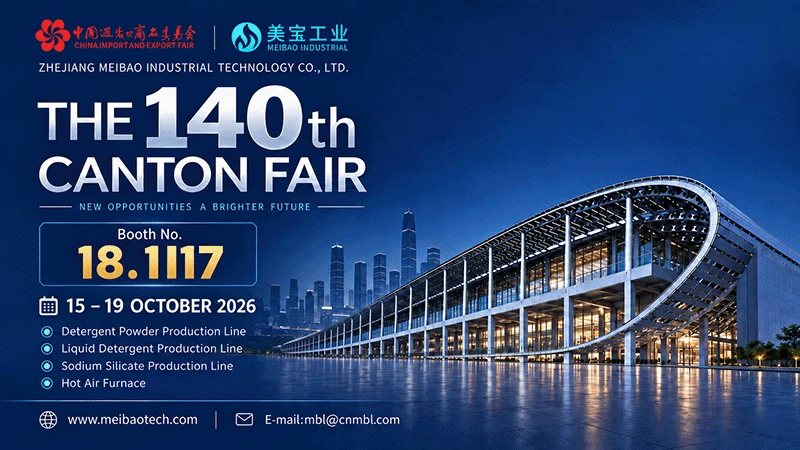
Meet Meibao at the Canton Fair, 15–19 October 2026, Booth 18.1I17, at the China Import and Export Fair Complex, No. 380, Yuejiang Zhong Road, Guangzhou, China.
To arrange a meeting, email mbl@cnmbl.com with a brief project introduction and your preferred visit date and time. If you cannot attend, you are welcome to contact us for an online discussion.