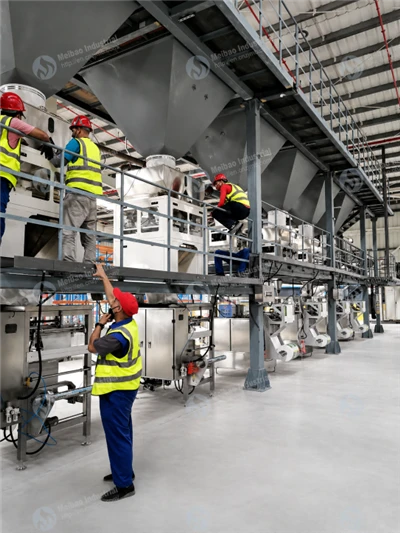


A useful liquid detergent production line quotation starts with the planned products, required output, packaging specifications, factory conditions and supply scope. These details help establish which production stages and equipment should be included.
A request such as "We need a liquid detergent line" opens the discussion, but does not yet define a comparable equipment proposal. Even the same output target can lead to different configurations when product characteristics, operating hours and packaging requirements differ.
1.Identify the Products You Plan to Manufacture
Start with the product names, such as liquid laundry detergent, dishwashing liquid or liquid hand wash. If several products are planned, identify the main product and the expected output of each.
Product variety affects mixing, storage, transfer and cleaning arrangements. Different formulations should not automatically be assumed suitable for the same equipment without adjustment. Sharing production equipment requires an assessment of process compatibility and changeover requirements.
2.Define Capacity Together with Operating Time
State whether your target is measured per hour, per batch or per day. Include the intended daily operating hours and, where relevant, the number of shifts.
For batch production, output depends on the working batch size and the complete cycle, including ingredient addition, mixing, any required heating or cooling, and discharge. Product changes and cleaning also affect available production time.
Tonnes, litres and bottle counts describe different quantities. Converting between them requires confirmed product density and filling quantity. Likewise, a tank's stated volume does not directly indicate hourly production capacity.
3.Describe the Formulation and Product Characteristics
Useful information includes the expected viscosity, whether raw materials arrive as liquids, powders or pastes, and whether the process requires heating or cooling. If viscosity data are available, include the measurement temperature.
These details help assess mixing arrangements, material handling, transfer and temperature-control needs. Any known foaming or cleaning requirements should also be mentioned.
You do not need to submit a complete confidential formula to begin an enquiry. If formulation development is still underway, provide the target product and basic requirements. Additional process information can be discussed as the proposal develops.
4.Clarify Where the Production Line Starts and Ends
Explain whether you need liquid preparation and mixing only, or a wider system covering raw material handling, storage, transfer, filling and packaging.
Liquid preparation capacity and filling speed must be assessed separately, then matched. A filling rate in bottles per hour is meaningful only when the container size and filling quantity are specified. Buffer storage may help coordinate batch preparation and filling, but its required capacity depends on the production schedule.
Meibao's liquid detergent production equipment page outlines the main equipment groups that can be considered when defining this scope.
5.Provide Packaging Details Where Relevant
If filling and packaging are included, share the container type, filling volume, cap style, label requirements and final packing format. Bottle drawings, photographs or samples can help clarify the intended package.
For several package sizes, indicate the expected output for each and how frequently formats will change. These details affect the assessment of filling, capping, labelling and conveying equipment. A liquid preparation system alone does not define the packaging configuration.

6.Explain Factory and Utility Conditions
Confirm whether the project involves a new factory or an existing building. Provide the project location, available floor space, usable height and any layout drawing already available.
Describe the electricity supply, water source and available heating or cooling utilities. Existing utility capacity and connection points help identify what can be used and what requires further assessment.
If some information is unavailable, mark it as pending. Identifying an unknown condition is more useful than building the proposal around an unconfirmed assumption.
7.Specify Automation and Supply Responsibilities
Explain which operations you want automated, such as dosing, transfer, process control or packaging. List existing equipment that you intend to retain and any systems to be supplied by others.
Homogenization, vacuum processing, clean-in-place (CIP) and PLC or DCS control should be evaluated against the actual process and operating requirements. They should not be treated as standard inclusions in every quotation.
Also clarify whether the requested scope includes engineering, installation, commissioning and training. Meibao's liquid detergent plant solutions provide an overview for discussing the wider project.
Start with Four Basic Details
To begin your enquiry with Zhejiang Meibao Industrial Technology Co., Ltd., send your product type, target capacity with units, packaging specifications and project location to mbl@cnmbl.com.
Factory information, process details and supply boundaries can be clarified during subsequent technical discussions.