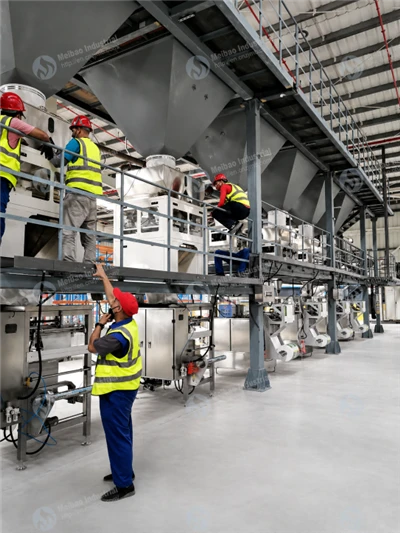

A complete detergent powder production line is more than a spray tower because the tower performs only one essential stage: converting prepared slurry into detergent base powder. A market-ready product also depends on raw material handling, slurry preparation, drying, base powder treatment, post-addition, screening, conveying and packaging. These stages must work as one process rather than as unrelated machines.
What the Spray Tower Does-and What It Does Not Do
In a spray-drying process, powder and liquid raw materials are measured and mixed into a slurry. The slurry is atomized into a hot-air stream inside the tower, where moisture is removed and base powder is formed.
The tower influences drying performance and powder characteristics, but it cannot correct inaccurate upstream dosing. Nor does it complete cooling, post-addition, screening or packaging. If the surrounding sections are poorly matched, a capable tower can still sit inside an inefficient production system.
How the Main Process Stages Work as One System

Raw Material Storage and Dosing
Powder and liquid materials need suitable storage, transfer and dosing arrangements based on their characteristics and the formula. Dosing determines what enters the process, while transfer equipment must supply the next stage at the required rate. The main question is whether these functions remain coordinated with slurry preparation and the production schedule.
Slurry Preparation and Spray Drying
Slurry preparation combines the selected materials into a feed suitable for spray drying. Its operating conditions must be coordinated with the tower and hot-air system. Changes in formula, feed condition or target powder specification may affect how these sections are configured and controlled.
Base Powder Cooling and Post-Addition
After drying, the base powder normally requires further handling before packing. Heat-sensitive ingredients that are generally unsuitable for the high-temperature drying stage-such as fragrance, enzymes, colored speckles or other functional additives-may be added later according to the formula.
Dosing, blending and powder flow must be coordinated. Because products do not all require the same post-addition modules, the formula should be reviewed before the equipment list is fixed.
Screening, Conveying and Packaging
Screening prepares the powder for consistent downstream handling, while conveying links the process to storage or packaging. Packaging equipment must match the required pack formats, filling method and production flow.
A downstream bottleneck can restrict the upstream process. Packaging should therefore be considered during line planning, not added as an isolated final purchase. For an overview of line types and equipment categories, review Meibao's detergent powder production line options.
Why Project Conditions Determine the Final Configuration
A detergent powder plant should not be copied from a generic equipment list. The configuration depends on connected project conditions:
-
Formula: raw material handling, slurry preparation and post-addition
-
Target capacity: equipment sizing, material flow and batch or continuous operation
-
Powder requirements: drying, cooling, screening and handling
-
Local energy: selection and integration of the hot-air system
-
Packaging formats: downstream equipment and line balance
-
Factory conditions: layout, utilities, installation and future expansion
Automation must also fit the project. Semi-automatic and automatic configurations can both be appropriate, depending on capacity, labor conditions, control needs and investment priorities. A fully automatic line is an option, not a universal requirement.
One Decision Comes Before the Equipment List
An early question is whether the manufacturer will produce detergent base powder from raw materials or purchase base powder and complete only the later stages.
The first route may require slurry preparation and spray drying. The second may use a post-blending line for ingredient addition, blending, screening and packaging without a spray tower. Both can form a complete solution under different business conditions.
This distinction will be explored in a separate guide: "Spray Drying or Post-Blending? How to Choose a Detergent Powder Production Route."
Why Engineering Integration Matters
Production-line engineering focuses on the interfaces between material flow, process control, heating, conveying, packaging, utilities and plant layout. Evaluating these interfaces together allows the equipment to be configured around the actual product and site.
Meibao coordinates process design, equipment manufacturing, installation, commissioning and operator training within its turnkey detergent powder plant solution. The objective is a connected production system, not a spray tower supplied without the surrounding process.
What to Provide for an Initial Project Assessment
For an initial assessment, provide:
-
Target product and available formula or specification
-
Required capacity and operating schedule
-
Raw-material or purchased-base-powder route
-
Required powder characteristics
-
Available fuel or energy conditions
-
Packaging sizes and formats
-
Factory dimensions, site conditions and utilities
-
Preferred automation level and expansion plan
-
Project country and applicable environmental requirements
Share these details with Meibao to request an initial project assessment. They help determine the process route, major production modules and technical questions to confirm before a proposal is prepared.
Frequently Asked Questions
What equipment is normally included in a detergent powder production line?
Depending on the process, a line may include raw material storage and dosing, slurry preparation, spray drying, base powder cooling, post-addition and blending, screening, conveying, finished-powder storage and packaging. The exact scope depends on the formula, capacity and site.
Does every detergent powder plant need a spray tower?
No. A plant that manufactures base powder from raw materials may require spray drying. A manufacturer with a reliable base powder supply may instead use a post-blending route. The choice depends on product and business conditions.
Must a complete detergent powder line be fully automatic?
No. Semi-automatic and automatic systems are both possible. The appropriate level should reflect production capacity, labor conditions, control requirements, budget and future plans.
What information is needed before a technical proposal can be prepared?
Useful starting information includes the target product, formula or specification, capacity, production route, powder requirements, available fuel, packaging formats, factory conditions, automation preference and project location.