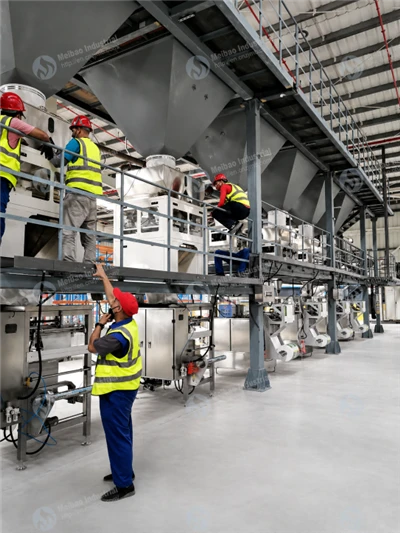

A customer's request for "about 130°C hot air, roughly 3 MW and biomass fuel" is a useful starting point - but it is not enough to specify the final furnace or drying system. This article explains how Meibao engineers a customized corn drying solution from process conditions, not from a fixed temperature.
When a customer says, "We need approximately 130°C hot air, a heating capacity of about 3 MW, and wood chips or biomass pellets as fuel," these figures provide a useful starting point. However, they are not enough to determine the final hot air furnace or corn drying system.
A suitable grain drying project cannot be designed by simply matching a standard furnace model to a required temperature. Corn characteristics, processing capacity, initial and target moisture content, dryer type, local climate, available fuels, energy prices and emission requirements all affect the final configuration.
Meibao therefore treats the hot air furnace as one part of a complete grain drying system. Each system is engineered according to the customer's production requirements and local technical and economic conditions.
Is 130°C the Correct Corn Drying Temperature?
Before selecting equipment, the engineering team must first confirm the exact drying requirements.
Important project information includes:
- Corn processing capacity per hour or per day
- Initial moisture content
- Required final moisture content
- Intended use of the dried corn
- Daily operating hours
- Continuous or intermittent operation
- Dryer type, airflow and system resistance
- Local ambient temperature and humidity
- Required automation level
The intended use of the dried corn is particularly important. Corn for food processing, animal feed, industrial applications or long-term storage may have different requirements for temperature, drying speed and process-air cleanliness.
The exact location of the specified temperature must also be confirmed. For example, 130°C may refer to:
- Hot air furnace outlet temperature
- Temperature after hot and cold air mixing
- Air temperature entering the corn dryer
- Maximum design temperature of the system
These temperatures are not necessarily the same. Their differences affect furnace design, mixing-air control, duct insulation, sensor placement and the control strategy of the complete drying system.
Therefore, 130°C should be treated as an initial process condition for a specific project, not as a standard temperature for every corn drying application.
When a customer specifies 130°C, the first question is not which furnace model should be selected. The engineering team must first confirm where the temperature is measured, how much water must be removed per hour, and how the dryer uses the supplied hot air.

Meibao hot air furnace and grain drying equipment. Equipment shown is for illustration of a complete hot air and drying system configuration.
Heating Capacity Cannot Be Determined by Temperature Alone
A required temperature does not directly indicate how much heat the project needs.
The actual thermal capacity mainly depends on the amount of moisture that must be removed from the corn. Engineers first calculate the hourly water evaporation load and then consider:
- Heat required to evaporate water
- Heat absorbed by the corn
- Heat carried away by exhaust air
- Heat losses from the dryer and hot air ducts
- Local ambient temperature
- Air humidity and altitude
- Operating load fluctuations
- Overall system efficiency
In the example discussed in this article, 3 MW is approximately equal to 2.58 million kcal/h. However, this figure should only be regarded as a preliminary project condition unless it has been confirmed through a complete heat balance calculation.
Heating capacity and fuel consumption are also different concepts.
Actual fuel consumption depends on:
- Fuel net calorific value
- Fuel moisture content
- Combustion efficiency
- Furnace configuration
- Actual operating load
- Local environmental conditions
- Overall system heat losses
For this reason, Meibao does not apply one fixed fuel consumption figure to every corn drying project. Estimated fuel consumption is calculated after the customer's site conditions and actual fuel data have been confirmed.
How Local Energy Conditions Affect Furnace Selection
A fuel may be technically suitable but economically unsuitable in the customer's local market.
The final energy solution should be selected according to local fuel availability, price stability, transportation distance, storage conditions, fuel quality, environmental requirements and expected annual operating time.
Wood Chips
Wood chips may have a relatively low local purchasing cost, especially in regions with forestry or wood-processing industries.
However, wood chip moisture, particle size and calorific value can vary significantly. These factors affect combustion stability and the design of the storage silo, conveyor, feeder, grate and combustion chamber.
Biomass Pellets
Biomass pellets generally have more consistent particle size, moisture and calorific value. They are usually easier to store, transport and feed automatically, which can support more stable combustion and temperature control.
Their purchase price may be higher than that of untreated wood chips. Therefore, the comparison should be based on the cost per unit of useful heat rather than only the fuel price per tonne.
Natural Gas and Oil
Natural gas can provide fast response and accurate temperature adjustment where a reliable gas supply is available.
Oil-fired systems may be considered in areas where liquid fuel is readily available but natural gas infrastructure is limited. The customer should evaluate long-term fuel prices and supply stability before making the final decision.
Coal
Coal may remain economically available in some markets. However, ash handling, dust control, emissions and process-air cleanliness must be evaluated carefully.
The final fuel choice should balance:
- Initial equipment investment
- Local fuel price
- Fuel calorific value and moisture
- Supply reliability
- Storage and handling costs
- Labour requirements
- Maintenance requirements
- Emission-control costs
- Long-term operating expenses

Wood chips, biomass pellets and the corresponding automatic feeding system. Fuel handling design depends on local fuel characteristics and supply conditions.
Direct-Fired or Indirect-Fired Hot Air Furnace?
Both direct-fired and indirect-fired systems can provide process air at approximately 130°C, but they operate differently.
Direct-Fired System
In a direct-fired system, cleaned high-temperature gas is adjusted to the required process temperature and then used for drying.
This system normally has a relatively simple heat-transfer path and can provide high thermal efficiency. However, process-air cleanliness must be evaluated according to the corn application, fuel characteristics, purification configuration and local standards.
Indirect-Fired System
In an indirect-fired system, the combustion gas and process air are separated by a heat exchanger. The dryer receives heated clean air without direct contact with the combustion gas.
This configuration may be preferred when the customer has stricter requirements for product cleanliness or combustion-gas isolation. It may also involve a more complex system and additional heat-transfer losses.
The correct choice cannot be made from temperature alone. The Meibao Engineering Team also evaluates:
- Corn application and quality requirements
- Fuel type
- Dryer design
- Required process-air cleanliness
- Local food or feed requirements
- Project investment budget
- Expected operating costs

Direct-fired and indirect-fired hot air furnace equipment and process comparison. The suitable configuration depends on corn application, fuel and cleanliness requirements.
How Can Stable 130°C Process Air Be Produced?
In a direct biomass-fired system, fuel is delivered to the combustion chamber through a specially designed feeding system. High-temperature gas passes through the relevant purification section before entering the mixing chamber.
Under the appropriate design conditions, high-temperature gas can be mixed with controlled ambient air to obtain the process-air temperature required by the dryer, such as approximately 130°C.
The automatic control system can coordinate:
- Biomass feeding rate
- Combustion-air volume
- Furnace pressure
- Cold-air mixing volume
- Process-air temperature
- Hot-air fan operation
- Actual dryer load
If 130°C refers to the air entering the corn dryer, the main temperature sensor and control point should be arranged at the corresponding position. If it refers to the furnace outlet, the control layout will be different.
According to Meibao's published industrial furnace data, certain direct biomass-fired systems can provide process air within a broad temperature range. Under specified design conditions, reference performance may include thermal efficiency above 95% and continuous temperature stability of approximately ±5°C.
Indirect-fired systems can also cover typical grain drying temperature requirements. Some gas- or oil-fired configurations have higher reference thermal efficiency under their specified design conditions.
These figures demonstrate Meibao's general equipment capabilities. The final temperature range, thermal efficiency, control accuracy and fuel consumption must be confirmed in the project-specific technical proposal.

PLC control cabinet, HMI and hot air temperature monitoring. Reference performance figures must be confirmed in the project-specific technical proposal.
The Hot Air Furnace Is Only One Part of the System
A complete corn drying project is not simply a furnace connected to a dryer.
Depending on the customer's required supply scope, the complete system may include:
- Corn receiving and conveying equipment
- Grain drying equipment
- Hot air furnace
- Fuel storage and feeding equipment
- Combustion-air and mixing-air systems
- Heat exchanger, if required
- Fans and hot air ducts
- Dust collection and emission-control equipment
- Corn discharge and cooling equipment
- Electrical control system
- PLC and HMI
- Safety interlocks and alarm systems
These components must be designed as one coordinated production system.
The project layout must also consider the customer's available factory space, material flow, fuel delivery route, maintenance access, electrical conditions and connection with existing equipment.
This is why Meibao supplies customized grain drying equipment instead of offering the same fixed furnace configuration to every customer.

Complete grain drying system layout, 3D model or equipment arrangement. Component scope is confirmed according to the customer's required supply range.
Related Industrial Drying Project Experience
Meibao has developed hot air furnace and industrial drying systems for different materials and operating conditions in international markets.
Related project experience includes:
- Biomass-fired hot air furnace systems for rubber drying in Indonesia
- Industrial hot air systems for rubber drying in Malaysia
- Hot air furnace equipment for fertilizer drying in Thailand
- Customized industrial heating and drying systems for other material-processing applications
These projects are not presented as corn drying cases. Different materials require different temperature, airflow and cleanliness conditions.
However, the projects demonstrate Meibao's experience in:
- Evaluating locally available fuels
- Calculating project-specific heating requirements
- Designing continuous hot air systems
- Integrating furnaces with drying equipment
- Controlling process-air temperature
- Coordinating complete equipment delivery and commissioning
When an actual corn drying project is developed, its system parameters must still be calculated separately according to the customer's corn characteristics and local conditions.

Meibao hot air furnace / industrial drying project delivered for an overseas customer. Shown to illustrate Meibao's engineering experience - this is not presented as a completed corn drying case.
Balancing Initial Investment and Long-Term Energy Cost
The lowest equipment price does not always result in the lowest total project cost.
One fuel may require less initial investment but result in higher long-term operating expenses. Another fuel may have a lower local price but require larger storage space, more complicated feeding equipment or additional emission-control systems.
When developing a grain drying solution, the engineering team should compare:
- Equipment investment
- Fuel cost per unit of useful heat
- Electricity consumption
- Labour cost
- Maintenance expenses
- Spare-part availability
- Fuel storage requirements
- Emission-treatment expenses
- Expected annual operating hours
The final solution should be technically reliable and economically suitable for the customer's local market.
This technical and economic evaluation is an important part of Meibao's customized grain drying system design.
What Information Should the Customer Provide?
To develop a suitable corn drying system, the customer should provide as much of the following information as possible:
- Project country and installation location
- Corn application and product requirements
- Required drying capacity
- Initial moisture content
- Target final moisture content
- Required process-air temperature, if specified
- Exact temperature measurement location
- Daily and annual operating hours
- Existing dryer type, airflow and system resistance
- Available local fuels
- Fuel moisture, particle size and calorific value
- Local fuel and electricity prices
- Ambient temperature, humidity and altitude
- Local emission requirements
- Available factory layout
- Required automation level
After these conditions have been confirmed, Meibao can calculate the required heating capacity, compare different energy solutions and determine the appropriate drying process and equipment configuration.
Frequently Asked Questions
A Customized Solution for Every Grain Drying Project
No single temperature, fuel consumption or furnace configuration is suitable for every corn drying project.
The 130°C temperature, 3 MW heating capacity and biomass fuel discussed in this article represent an example application scenario. They should not be regarded as fixed specifications for every grain drying system.
Meibao designs complete grain drying equipment according to the customer's grain characteristics, moisture reduction target, production capacity, local fuels, energy prices, environmental conditions and investment plan.
Tell us your project country, corn drying capacity, initial and target moisture content, available local fuels and operating requirements. The Meibao Engineering Team will evaluate the technical and economic conditions and develop a customized grain drying solution for your project.
Discuss Your Corn Drying Project with Meibao
Share your project country, drying capacity, initial and target moisture, local fuels and operating requirements. The Meibao Engineering Team will evaluate the technical and economic conditions and propose a customized grain drying solution.
Contact the Engineering Team →About the Technical Review Team
Meibao Engineering Team
The Meibao Engineering Team provides customized process and equipment engineering for detergent production lines, chemical production equipment, industrial hot air furnaces, drying systems and resource recovery projects.
Its work covers process analysis, system configuration, local energy evaluation, equipment integration, automation design and project implementation.