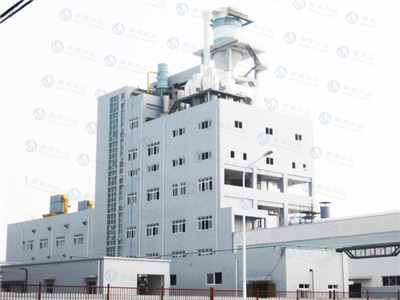


Calcium chloride can be produced for very different markets, so the production process should be decided by the final product rather than by using one fixed plant configuration.
A factory producing calcium chloride for food-related applications will have different requirements from a plant serving deicing, dust control, concrete, or chemical markets. Product form also matters. Powder, granules, and flakes require different downstream equipment and handling arrangements.
Zhejiang Meibao Industrial Technology Co., Ltd. designs calcium chloride production lines according to the customer's raw materials, required capacity, final product, and factory conditions.
The Process Depends on What You Need to Produce
A typical calcium chloride line can involve reaction, filtration, concentration, drying, forming, cooling, and packaging.
The exact route changes from project to project.
For example, after concentration, a customer producing granular calcium chloride may need a drying and granulation section, while another project may be designed for powder or flake production. This affects not only the main equipment, but also material transfer, cooling, storage, and packaging.
That is why the required product specification should be confirmed early in the project.

Concentration and Drying Are Key Sections
After reaction and filtration, the calcium chloride solution needs to reach the required concentration before it moves to the final forming stage.
At this point, production capacity, moisture requirements, heat supply, and final product form all need to be considered together.
If these sections are not properly matched, the downstream equipment may struggle to maintain stable operation or the required product condition.
Meibao therefore designs the concentration, drying, and forming sections as connected parts of the same process.

For Food and Industrial Markets
Calcium chloride is used in a wide range of applications.
Food-grade products can be used in selected food-processing and additive applications, while industrial-grade calcium chloride is commonly used for deicing, dust control, concrete acceleration, and chemical processing.
The required process, materials, quality-control arrangements, and product handling should be selected according to the intended market and applicable product requirements.

Automation According to Plant Size
PLC or DCS control can be included when the project requires more centralized operation.
The control system can be used to monitor important operating conditions such as temperature, material transfer, concentration, drying, and equipment status.
A smaller plant may not need the same automation level as a larger continuous-production facility, so the control configuration should match the actual project rather than adding functions that are not necessary.

Project Support from Design to Startup
Meibao can support calcium chloride projects from process planning and equipment manufacturing through installation guidance and commissioning.
The goal is to develop a production line that matches the customer's required product instead of forcing different projects into the same standard design.
Whether the target is powder, granules, flakes, food-grade material, or industrial-grade calcium chloride, the starting point is the same: define the product first, then build the process around it.

Contact Meibao to discuss your calcium chloride production project.
Email: mbl@cnmbl.com